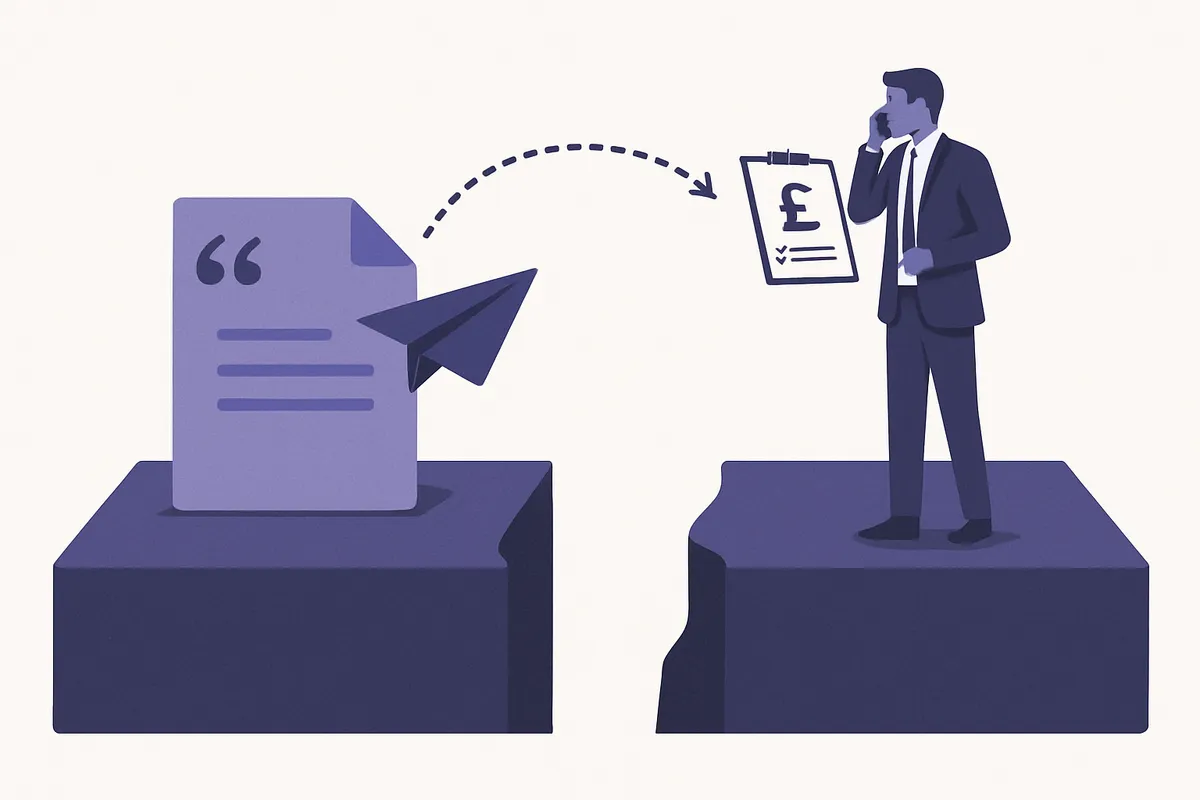
Most Quotes Go Cold Because Nobody Chases Them
A customer contacts you. You visit, measure up, and send a detailed quote. Then you wait.
A week passes. You assume they went with someone cheaper. The opportunity disappears without anyone officially closing it.
This is standard practice for most UK service businesses - and it is costing them thousands of pounds every single month.
The Follow-Up Gap
There is often a gap between how many contacts it takes to secure a customer, and how many a business actually makes.
A customer comparing quotes is busy, distracted, and often weighing two or three options. Many need a reminder before they commit. Yet when a quote goes unanswered, most small businesses send nothing, or a single chaser, and then move on.
The result is simple: customers who needed one more well-timed prompt end up booking whoever followed up.
Why Service Businesses Are Especially Vulnerable
B2B sales teams have CRM systems, pipeline managers, and quota accountability. A sole trader plumber or a three-person salon has none of that.
Their "pipeline" is a mental note, a WhatsApp message, or a quote PDF sitting in an email outbox. Following up on every quote means remembering who you quoted, when, what the job was, and at what price - while also running live jobs, managing staff, and handling new enquiries.
When follow-up doesn't happen, it is rarely laziness. It is capacity. There is no system, so follow-up depends entirely on the owner's memory and bandwidth - and when the diary fills up, the follow-up does not happen.
The Federation of Small Businesses puts the number of small businesses in the UK at 5.6 million at the start of 2025, with around three quarters of all private sector businesses having no employees at all. For most of them, every single customer touchpoint - including post-quote follow-up - runs through one person.
What "Going Cold" Actually Looks Like in Practice
A customer who requested a quote and did not immediately respond has not necessarily chosen someone else. Most people need time to evaluate options, and often welcome a well-timed prompt to make a decision.
In practice, a customer who went quiet after receiving a quote might be:
- Waiting to compare with one or two other quotes before deciding
- Dealing with something else that delayed the decision
- Trying to free up budget or confirm timing
- Genuinely undecided and needing a small nudge
In all of these cases, a thoughtful follow-up - a brief message a few days later confirming availability and asking if they have questions - can be enough to close the job.
The problem is that without a system, this follow-up either does not happen at all, or it happens too late to matter.
The Revenue Maths of Better Follow-Up
The numbers here are not abstract. Consider a mid-size trades business sending 15 quotes per week at an average job value of £600, with a current conversion rate of 35%.
At 35%, that is roughly five jobs booked from 15 quotes - around £3,000 in booked work per week.
If a structured follow-up process lifts conversion to just 45%, that is nearly seven jobs booked from the same 15 quotes - approximately £4,050 per week. That is an extra £1,050 per week from exactly the same lead flow, with no increase in marketing spend or advertising cost.
Over a year, the difference is roughly £54,000 in additional revenue - from quoting the same volume of work, just following up on it properly.
The improvement does not require being more skilled or undercutting on price. It requires being the business that followed up when the competitor did not.
The Timing Window Most Businesses Miss
Follow-up effectiveness decays rapidly with time. A customer comparing two electricians is likely making their decision within three to seven days of receiving quotes. After a fortnight, they have either booked someone or indefinitely shelved the project.
That three-to-seven-day window is precisely when most busy business owners are not thinking about a quote they sent last week. They are focused on jobs already in the diary, managing materials, or chasing payments. Last week's unanswered quote is not front of mind.
This is where timing matters more than the content of the follow-up. A short, professional message within the decision window - "Just checking in on the quote I sent over, happy to answer any questions" - reads as attentive rather than pushy. The businesses that send this message consistently close more work than those that do not, often at the same price point.
The Problem Compounds Over Time
Beyond individual lost quotes, the follow-up gap creates a structural problem for business growth.
Service businesses tend to have lumpy revenue - some months are full, some are lean. During busy periods, there is no incentive to chase quotes because the diary is already full. During quiet periods, the phone is not ringing and the quote pipeline feels empty.
What actually happens is that during busy periods, dozens of warm quotes go cold because nobody followed up. Then when the busy period ends, there are no warm leads left - just cold ones that have long since hired someone else.
Businesses that maintain consistent follow-up throughout their busy periods find that their quiet periods are shorter and less severe. The pipeline stays warm because the follow-up never stops.
What a Proper Follow-Up System Looks Like
Consistent follow-up does not require a dedicated salesperson or a sophisticated CRM. For most UK service businesses, a basic sequence works well:
Day 1: Quote sent. The customer receives a professional quote with clear pricing, scope, and contact details.
Day 4-5: First follow-up. A brief message checking in, offering to answer questions, and confirming availability.
Day 10-12: Second follow-up, if no response. A short message acknowledging they may still be deciding, and noting that the quote is valid until a specific date.
Day 20+: Final close-out. A message confirming the quote is about to expire and asking if they would like to rebook for a later date.
Many jobs are won on the second or third touch, from customers who were simply busy or still comparing options. The key is that the sequence happens without relying on the owner to remember it.
Where Automation Makes the Difference
The barrier to consistent follow-up is not motivation - most business owners know they should be doing it. The barrier is that it requires a reliable system that does not depend on a single person's memory or energy.
Automated follow-up sends the right message at the right time regardless of how busy the business is. For businesses already using a job management tool or quoting platform, triggering a follow-up sequence when a quote is marked as "sent" is a straightforward addition.
The follow-up messages themselves can be reviewed before sending, or queued automatically with a standard template. Either way, the result is the same: no quote falls through the cracks during a busy week, and no potential customer is simply abandoned because the owner ran out of time to follow up.
For a service business sending 10 to 20 quotes per week, the cumulative value of capturing even a fraction of those cold opportunities is substantial - often more impactful than spending money on new lead generation.
Sources
- Federation of Small Businesses: UK Small Business Statistics - Source for UK small business population data
Ready to automate the time-wasting parts of your business? Book a free consultation with ORYX.
Frequently asked questions
Why is follow-up so crucial for UK service businesses?
Follow-up is crucial because most sales require multiple contacts before a customer commits. Without consistent follow-up, opportunities slip away as potential customers may opt for a more persistent competitor.
How many follow-up attempts do successful sales usually require?
There is no fixed number, but many customers need more than one prompt before they commit. A structured sequence of two or three well-timed follow-ups makes sure no quote is left to go cold by accident.
Why do many small UK service businesses struggle with follow-up?
Small service businesses often lack dedicated systems for managing follow-ups, relying instead on memory or manual notes. When the workload increases, owners may not have the capacity to remember and reach out to every potential customer, leading to missed sales.
Ready to automate the time-wasting parts of your business?
Book a free consultation